
The Union Budget for 2026-27, presented by Finance Minister (FM) Nirmala Sitharaman on Sunday, which was a first, had an excellent domestic macro backdrop. According to the first advance estimates, gross domestic product (GDP) in constant prices is projected to grow 7.4 per cent in the current financial year, against 6.5 per cent in 2024-25.

The Union Budget 2025-26 had allocated Rs 2,33,210.68 crore (BE) to the ministry helmed by Union Home Minister Amit Shah.

Nirmala Sitharaman presents the National Democratic Alliance government's budget amid high hopes and expectations from across the spectrum of society -- from farmers to industralist. Will the Budget fulfill the expectations of all?

Among its 27 recommendations for the Union Budget is this: It has suggested that equity investments held for more than one year and up to three years should be taxed at 12.5 per cent on gains exceeding 2 lakh in a financial year.

The Budget reframes healthcare as a strategic national capability, backing biopharma innovation, workforce expansion and technology-led governance to power India's next growth phase.

'We kept this Budget on a larger plank, rather than on one incident, however serious.'

The Opposition on Tuesday termed the Union Budget as a 'kursi bachao budget' driven by political compulsions and claimed that it ignored opposition-ruled states in a bid to 'appease' Bharatiya Janata Party's allies.

Reiterating Sitharaman's statement that this is a youth power budget, Modi emphasised that the provisions made in the budget will prepare leaders, innovators and creators across different sectors.

Enforcement agencies have highlighted risks related to money laundering and terror financing, prompting closer scrutiny of crypto platforms operating in India.

The best course for the government at this time would be to tighten the seat belt a little more, without compromising on its investments in creating better infrastructure and giving a push to privatisation, points out A K Bhattacharya.

The Centre has announced that the Viksit Bharat -- Guarantee for Rozgar and Ajeevika Mission (Gramin) Act will come into force across the country from July 1, replacing the Mahatma Gandhi National Rural Employment Guarantee Act.

Capex, infrastructure development, and prudent fiscal management are the key focus areas in the Budget, says Nilesh Shah.

The Indian Parliament is expected to extend its budget session to introduce a bill increasing Lok Sabha seats to 816, reserving 273 for women, and amending the women's reservation law.

The government's flagship Khelo India programme received an allocation of Rs 924.35 crore.

The Indian government's announcement of 10,000 additional seats in medical colleges next year, part of a plan to add 75,000 seats over five years, has been welcomed by education experts and stakeholders. The move aims to address the shortage of medical professionals and reduce the outflow of Indian medical students to other countries. The budget also includes infrastructure expansion at five new IITs to accommodate 6,500 more students and an allocation of Rs 500 crore to set up a Centre of Excellence in Artificial Intelligence for education.

The Centre has notified draft rules for the Viksit Bharat - Guarantee for Rozgar and Ajeevika Mission (Gramin) Act, 2025, outlining the framework for the new rural employment programme replacing MGNREGA. The draft rules are open for public feedback until June 21, 2026.

Two of the three strikes are related to the gig economy, a centrepiece of the new labour Codes.

Two dedicated freight corridors -- Eastern and Western -- are in operation covering several states and districts.

Three laws passed in Parliament could boost central revenues, reshape GST cess flows, shift MGNREGA costs to states and create new budget headroom ahead of the 2026-2027 Union Budget, points out A K Bhattacharya.

The proposals outlined in Budget 2026-27 represent a carefully crafted, multi-year strategy designed to strengthen India's big bets on the path to Viksit Bharat 2047, says Sameer Gupta.

Kerala, Tamil Nadu and West Bengal have been fiscally stressed for a considerable period of time, and there are no easy ways to mobilise revenues to meet the cost of the promised freebies, particularly in the prevailing difficult economic scenario, points out M Govinda Rao.

Finance Minister Nirmala Sitharaman's biggest challenge will be to find a new growth driver, particularly against the backdrop of a global economy ravaged by heightened uncertainty and fragmentation, financial markets on a precipice, and global commodity prices on a continued uptrend.
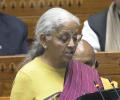
The government has proposed to lower debt-to-GDP ratio to 55.6 per cent in FY27, from 56.1 per cent in the current fiscal year, Finance Minister Nirmala Sitharaman said on Sunday.
The government has proposed to lower debt-to-GDP ratio to 55.6 per cent in FY27, from 56.1 per cent in the current fiscal year, Finance Minister Nirmala Sitharaman said on Sunday.

Watch as Nirmala Sitharaman unveils India's economic roadmap for the next fiscal year and beyond.

It is learnt that India was mulling various options relating to the project after Trump administration threatened a 25 per cent additional tariff on countries doing business with Tehran.

The Reserve Bank of India (RBI) has projected a 6.9 per cent GDP growth for the current financial year, citing concerns over commodity prices and supply chain disruptions stemming from the West Asia crisis.

During 2023, the Indian real estate sector - both housing and commercial - witnessed buoyancy fuelled by demand, supply, and absorption, and the sector is banking on the upcoming Budget to keep the momentum going. Mumbai-based Sattva Group wants the government to focus on the critical pillars for long-term growth. The company emphasised on the infrastructure boom with increased allocation, lower goods and services tax (GST) rates, incentives for affordable housing and single-window clearance to fast-track projects and support liquidity.

Investors and startup executives are calling for extending the period for an entity to be recognised as a startup from 10 to 15 years for deep-tech companies.

Finance Minister Nirmala Sitharaman on Sunday proposed a six-month foreign asset disclosure scheme for small taxpayers like students, tech professionals and relocated NRIs as she presented the Union Budget 2026-27.

Amul and Mother Dairy, India's largest dairy product retailers, have increased milk prices by Rs 2 per litre, marking the second such hike in 13 months. This move is expected to intensify inflationary pressures, already fuelled by global conflicts, and will impact household budgets across the country.

The fiscal tilt towards capex benefits companies in investment-related sectors like capital goods, defence equipment, engineering & construction and metal & mining. The planned cut in revenue expenditure will weigh on companies in consumption sectors like FMCG, consumer durables and retail.

Customs regimes can lead to labyrinthine legal disputes. Budget 2026 must recognise that an excessively defensive Customs posture can itself become a trade barrier, point out Mukesh Butani and Shankey Agrawal.

The Budget offers a limited-time regularisation window with clear thresholds, defined payments, and immunity from penalty or prosecution.

Stock market is gearing up for an eventful week ahead where key triggers such as quarterly earnings from corporates, the US Fed interest rate decision and the upcoming Union Budget for 2026-27 would grab the limelight, analysts said.

Restoring weighted tax deductions and adopting a petty patents regime can foster firm-level innovative activity critical for competitiveness, points out Nagesh Kumar.

The Sports Ministry has got a fillip with the government allocating Rs 3,397.32 crore, an increase of Rs 723.97 crore, in the Union Budget on Wednesday.

India's retail inflation, measured by the Consumer Price Index (CPI), increased to 3.48 per cent in April, up from 3.40 per cent in March, primarily due to a surge in prices of gold and silver jewellery, as well as certain kitchen staples like tomatoes and cauliflower.

Shares of brokerage-related companies nosedived 18 per cent on Sunday after Finance Minister Nirmala Sitharaman proposed raising securities transaction tax on commodity futures to 0.05 per cent from 0.02 per cent in the Union Budget 2026-27.

While India's interplanetary ambitions remain significant, the current pace of financial and technical progress raises questions about whether the 2027-2028 timelines can be met.
 © 2026 Rediff.com - Advertise with us - Disclaimer - Privacy Policy - Sitemap - Feedback - About us - Terms of use - Grievances